
Trade Autopsy is included on both plans, with its own monthly allowance: 20 on Starter and 30 on Pro. See the plan comparison.
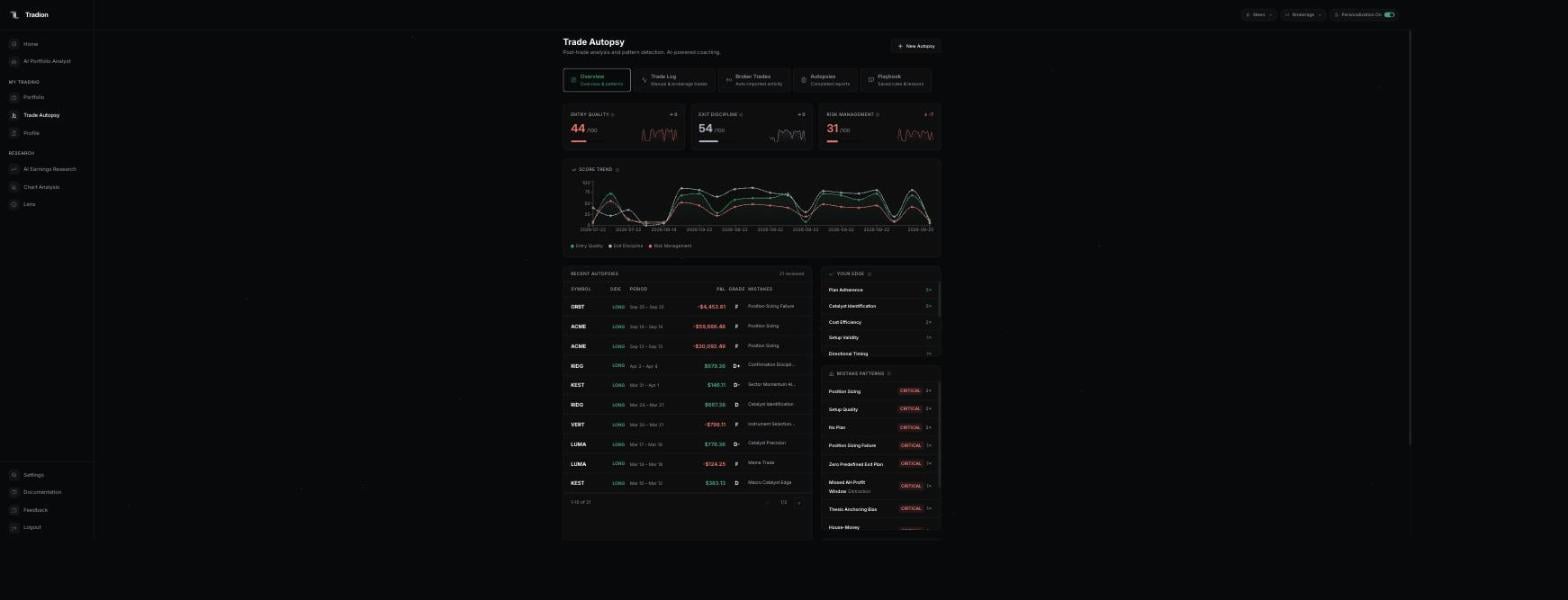
The Overview tab: your three scores, the trades you have logged, the patterns that keep repeating, and your pre-flight card.
What an autopsy is
A structured post-mortem of one closed trade. You give Tradion what happened; it returns a report with the same fixed sections every time, a reconstructed timeline, a breakdown of what the result is attributable to, three 0–100 scores, alternative versions of the trade, and one rule to carry forward.In plain English
One report tells you about one trade, and markets are noisy enough that a single sample proves little. Ten reports in an identical format are what make a repeated mistake visible. The report keeps process and outcome apart on purpose. A win taken on a broken process and a loss taken correctly look nothing alike, and the report grades both so you can see when the two disagree.The five tabs
On Overview, each score carries a sparkline that you read for shape rather than value, and the scatter plots one dot per trade against both grades at once. The two pattern panels are named Your Edge and Mistake Patterns.
Getting trades in
Four routes, and you’ll probably use all of them.Narrative
Type what happened. Tradion pulls the facts out of it.
Quick Facts
A form. Fastest when you have the numbers to hand.
Upload File
A screenshot or PDF of a broker confirmation.
Import from your broker
Closed trades rebuilt from your account history.
Running your first autopsy
1
Open Trade Autopsy and click New Autopsy
Pick Manual Entry to type or upload, or From Brokerage to work from an imported trade.
2
Describe the trade
A few sentences is enough: the ticker, why you entered, what your plan was, what you did, and how you felt. That last part matters more than it sounds, logging a trade explains why.
3
Answer the follow-up questions
Tradion asks 3–5 multiple-choice questions about the parts it couldn’t determine, usually your stop, your sizing, and your state of mind. Each has an Other option.
4
Read the report
Roughly 30–60 seconds later. Reading an autopsy walks through every section.
5
Save the lesson
Every report ends with one rule. Save to Playbook puts it somewhere you’ll see it again.
The trade and its report are both saved. The report appears under Autopsies, and the trade under Trade Log.
How patterns emerge
Each report tags the trade with the mistakes it found, and those tags are what patterns are built from. Nothing is learning here, Tradion groups identical tags, counts, and ranks them. Once a tag appears on more than one losing trade it becomes a pattern, carrying how often it happened, what those trades lost in total, and a severity score from 0 to 100.How severity is scored
Two parts, added together.- How often it happens is worth up to 60 points, measured against every trade you have reviewed. A tag on every reviewed trade takes all 60; a tag on a tenth of them takes 6.
- What it costs is worth up to 40 points, measured against your most expensive pattern. Your costliest pattern takes all 40; one that has cost half as much takes 20.
Why roughly ten trades
Ten is where several things switch on at once:- Below about 10 autopsies, Tradion won’t calculate a direction on your scores. There isn’t enough to split into a “before” and an “after”.
- Session analysis needs 5 trades in a given part of the day before showing a win rate for that window.
- At 20 autopsies, trend arrows and score changes appear, and Tradion Memory moves from low to moderate confidence.
Log your first trade
The three intake modes, and what to write.
Reading an autopsy
Every section of the report and what to do with it.